Sphota Theory

Why AI Can’t (Yet) Know Sphota

This post explores the ancient Indian concept of Sphoṭa — the holistic flash of meaning — and why it challenges how modern AI understands language. Drawing from Bhartr̥hari’s philosophy, it contrasts human consciousness with machine processing, revealing how real communication goes beyond syntax and symbols. A compelling read for those interested in AI, linguistics, Indian philosophy, and the future of meaning-making.

Why AI Can’t (Yet) Know Sphota Read More »
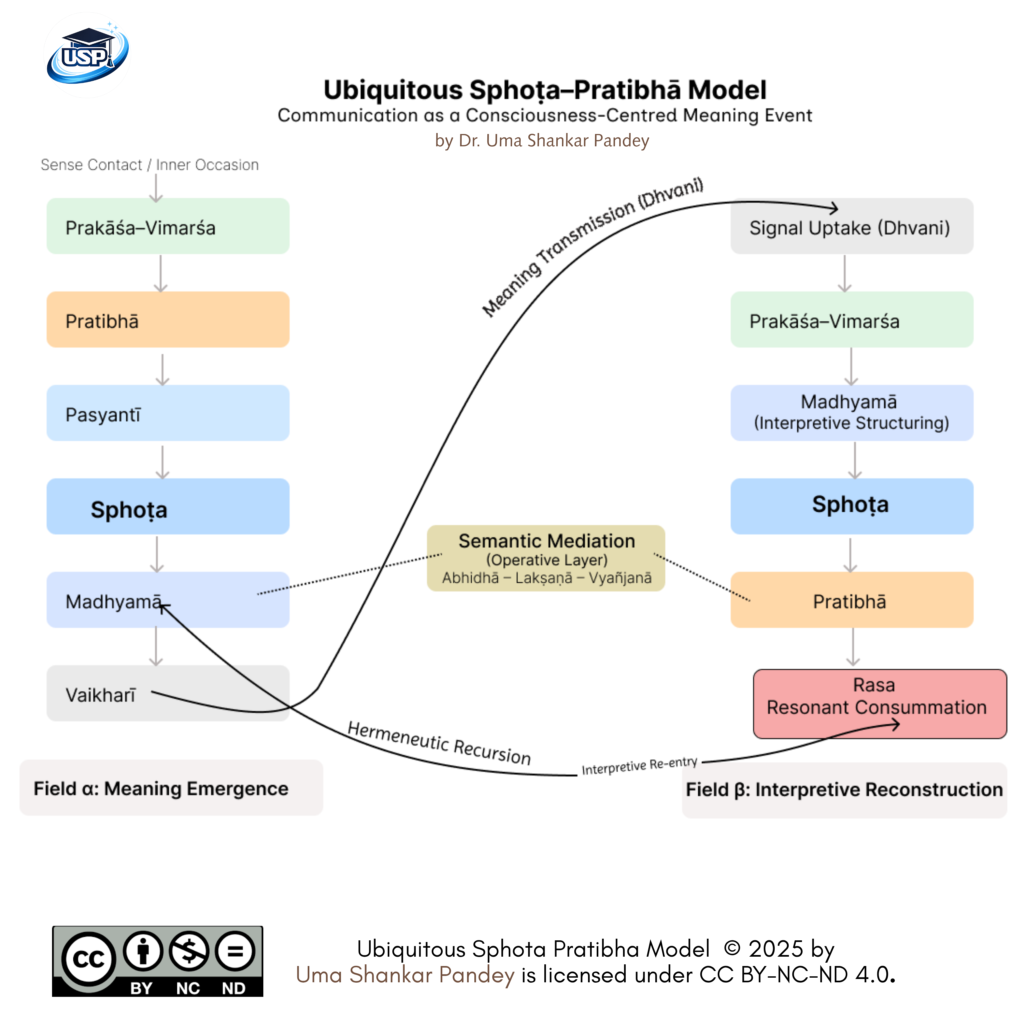
USP Model

Communication is not a transfer of information; it is the emergence and re-creation of meaning within consciousness. The Ubiquitous Sphoṭa–Pratibhā (USP) Model rethinks communication as a dynamic movement from reflexive awareness (Prakāśa–Vimarśa) through intuitive ignition (Pratibhā) and holistic insight (Sphoṭa) into expression (Vaikharī), followed by interpretive reconstruction in the receiver. Meaning travels not as fixed content but as Dhvani, unfolding through layered semantic mediation (Abhidha–Lakṣaṇā–Vyañjanā) and culminating in Rasa—resonant consummation. The process does not end there; it loops back through hermeneutic recursion, reshaping future cognition. By integrating Indian philosophical insights with contemporary concerns in cognition and communication, the USP Model offers a consciousness-centred framework for understanding meaning in human and AI-mediated environments.

USP Model Read More »

Scroll to Top