


The Ubiquitous Sphoṭa Pratibhā Model
Apprehension coordination and warrant in linguistic encounters
Developed by Dr. Uma Shankar Pandey
The Ubiquitous Sphoṭa–Pratibhā (USP) Model examines how an expression becomes intelligible to a person and what happens when that understanding enters an encounter with others. It connects lived apprehension with formulation, public response and examination of reasons. Its central distinction separates three achievements: apprehending an expression, coordinating an activity and having adequate grounds for accepting a claim.
Consider a student reading an AI explanation. The explanation feels clear. The student can repeat it and completes a worksheet with a partner. Yet a new problem exposes a gap. Here, felt intelligibility, joint progress and warranted understanding have travelled different paths. USP offers a framework for tracing those paths and investigating when they reconnect.
The central relation
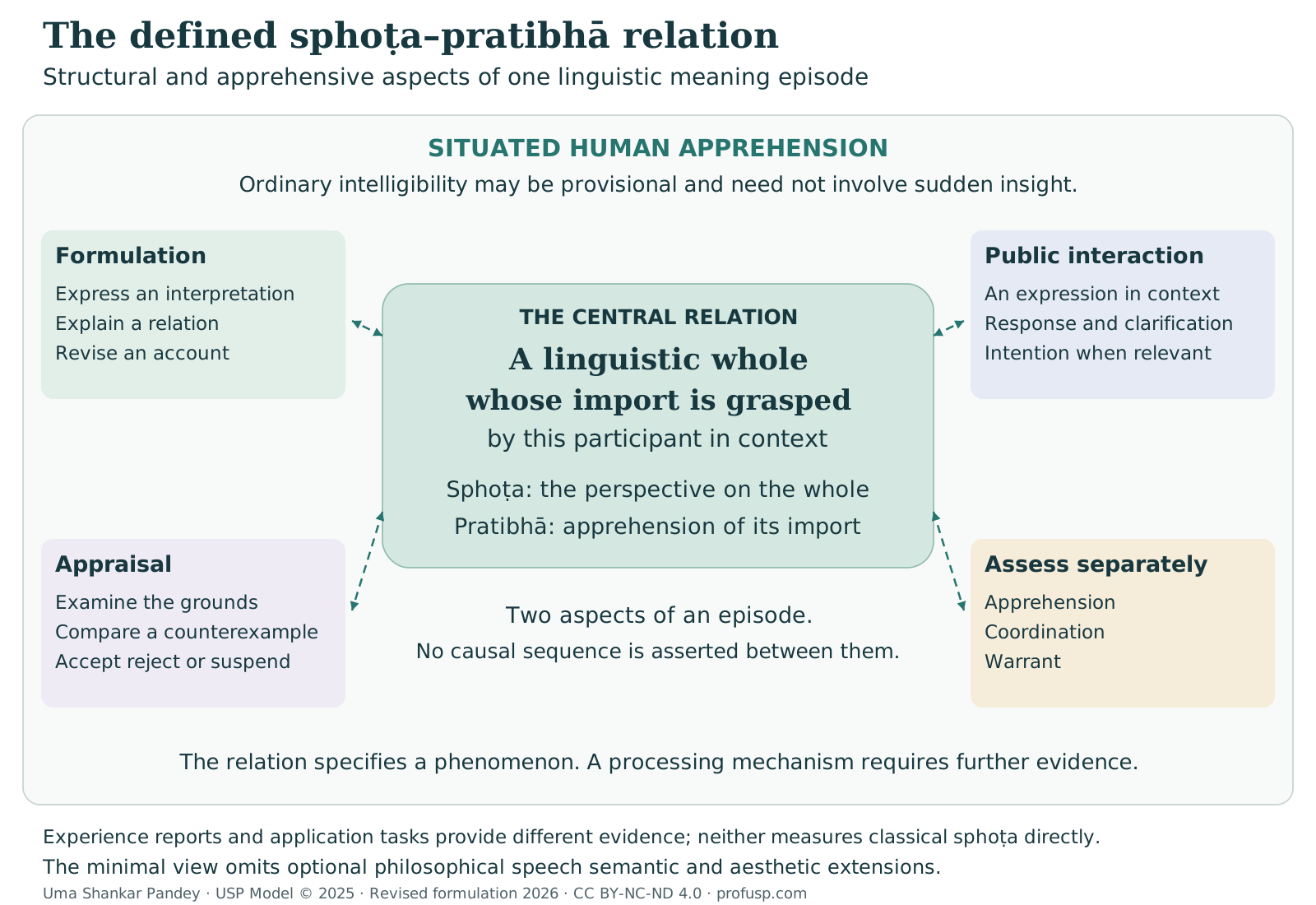
The centre has a specific meaning. In USP’s reconstruction, the sphoṭa–pratibhā relation is a participant’s apprehension of the import of an expression encountered as a linguistic whole. Sphoṭa supplies the perspective on the whole; pratibhā concerns its import becoming available to this participant in this situation.
These are structural and apprehensive aspects of a meaning episode. They are not two successive events or two independent mental objects linked by a processing arrow. Nor is pratibhā the inspection of a separate thing called sphoṭa. The relation concerns how an intelligible expression presents a significance that the participant can grasp.
“The meeting has moved upstairs” may immediately make sense as a reason to change one’s route. This ordinary apprehension need not arrive as a dramatic flash. It can also be mistaken: the listener might identify the wrong meeting. A coherent experience does not establish that the interpretation matches the speaker’s intention or survives scrutiny.
This use draws on Bhartṛhari’s philosophy of language while making a contemporary reconstruction explicit. It specifies what the model investigates; it does not yet identify a neural or computational mechanism. Studies must examine the proposed relations rather than treating a clarity rating as a direct measurement of classical sphoṭa.
Structural and apprehensive aspects of one participant’s linguistic meaning episode.
The defined central relation
A linguistic whole whose import is grasped by this participant in context.
Sphoṭa supplies the perspective on the linguistic whole. Pratibhā concerns apprehension of its import.
These are two aspects of an episode. No causal sequence is asserted between them.
Formulation
Express an interpretation, explain a relation or revise an account.
Public interaction
An expression in context, response and clarification. Investigate intended meaning when relevant.
Appraisal
Examine grounds and compare counterexamples. Accept, reject or suspend endorsement.
Independent assessment
Apprehension, coordination and warrant require different evidence. Experience reports and application tasks are not interchangeable.
The relation specifies a phenomenon. Identifying a processing mechanism requires further evidence. Philosophical, speech, semantic and aesthetic extensions are separate.
View publication figure
Scroll within the expanded view to inspect the full figure. Select the heading again to close it.
Three achievements that need separate assessment
Apprehension concerns a participant’s grasp of an expression’s import. Researchers should investigate both the experience and the participant’s ability to work with the relevant relations. A feeling of clarity and successful application are different kinds of evidence.
Coordination concerns whether participants organise their joint activity sufficiently for a stated purpose. Two people may complete a task while retaining different interpretations. They may also understand a request and refuse it. Coordination is therefore broader than agreement and differs from recovering everything a speaker intended.
Warrant concerns the adequacy of grounds for accepting a particular claim or interpretation. Those grounds may include a source record, an observation, an inference or a reason already known. Warrant is not identical to truth, confidence, consensus or simply changing one’s mind.
Fidelity to a speaker’s intended meaning is a further, task-dependent criterion. It can help explain coordination, but it is not another name for it. Intention must be investigated through appropriate evidence. In an AI encounter, a study can examine the system’s assigned task and the user’s attributions without presuming a machine’s phenomenal intention.
No component automatically produces an achievement. Apprehension supplies an interpretation that may be revised. Public response can support coordination or spread a mistake. Review can expose an interpretation; appraisal can assess its grounds. Whether those grounds are adequate requires independent judgment.
The minimal architecture
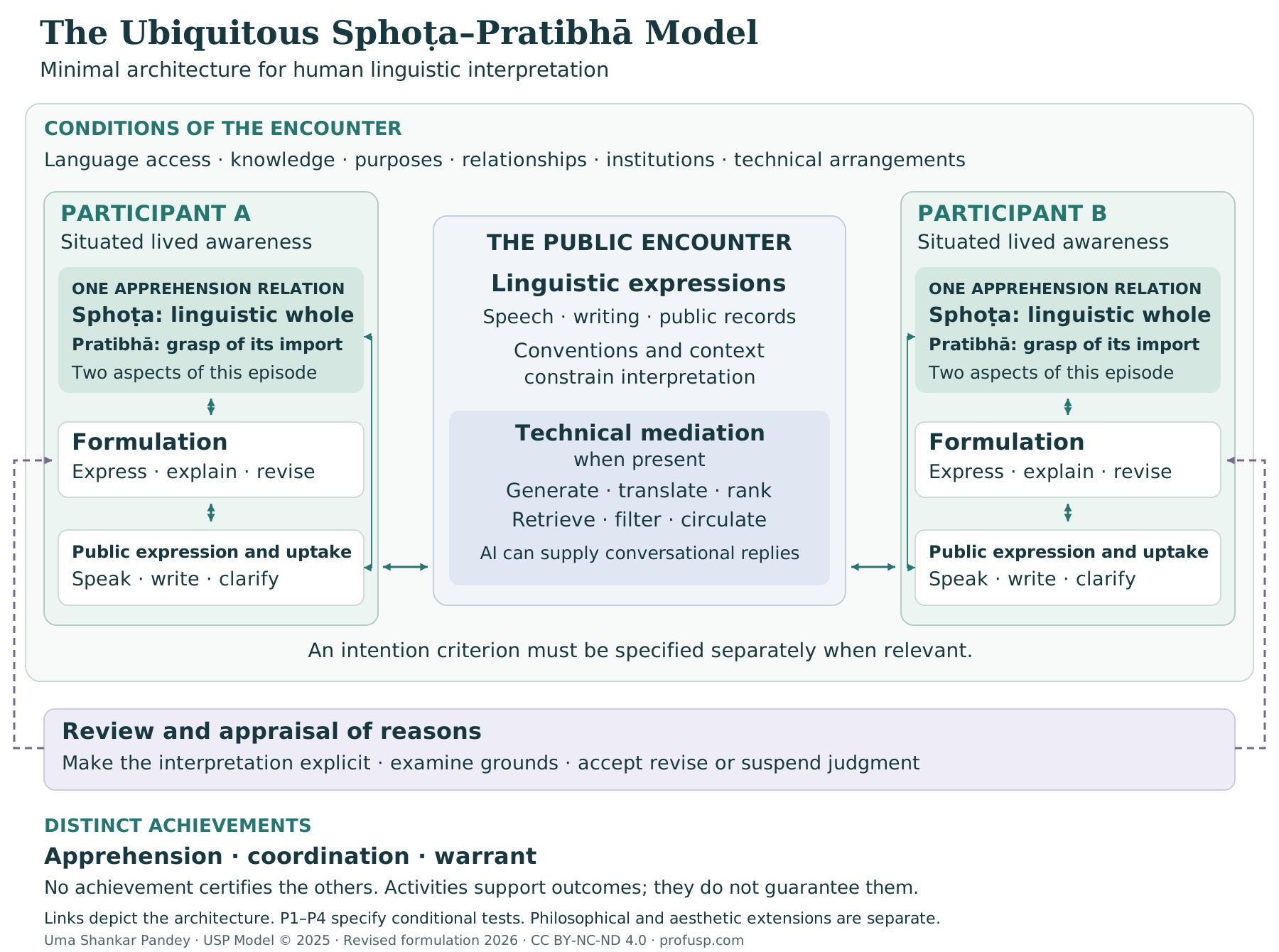
A situated participant encounters a linguistic expression, apprehends an import and may formulate, express or revise an account. Public responses bring that account into contact with other interpretations. Available reasons can support acceptance, rejection or suspension of judgment. Bodies, language competence, relationships, institutions and technical arrangements shape these possibilities.
The arrows describe relations that require specification in a study. They do not assert that every episode follows a fixed sequence. For a particular test, researchers must state which relations they predict, under what conditions and which result would count against them. An unfavourable result cannot be excused by saying afterwards that the relevant arrow was only possible.
Figure 1 presents this minimal architecture. Figure 2 defines its conceptual centre. Figure 3 applies it to human–AI communication. The smaller-screen versions arrange the figures vertically to preserve readable labels; the publication diagrams remain available in the expandable views.
A minimal architecture for linguistic interpretation. Each empirical study must specify the relations and conditions it tests.
Conditions
Language access, knowledge, purposes, relationships, institutions and technical arrangements.
Participant A
Situated lived awareness
One apprehension relation
A linguistic whole whose import is grasped by this participant in context.
Sphoṭa: perspective on the whole.
Pratibhā: apprehension of its import.
Formulate, express, explain or revise an account. Public responses can reshape the interpretation.
The public encounter
Linguistic expressions become available through speech, writing and public records. Conventions and context constrain interpretation.
Platforms and AI can generate, translate, rank, retrieve, filter or circulate expressions. An AI system can supply conversational replies.
Participant B
Situated lived awareness
One apprehension relation
A linguistic whole whose import is grasped by this participant in context.
Sphoṭa: perspective on the whole.
Pratibhā: apprehension of its import.
Formulate, express, explain or revise an account. Public responses can reshape the interpretation.
Review and appraisal
Make the interpretation explicit. Examine its grounds. Accept, revise or suspend judgment. Appraisal does not guarantee adequate reasons.
Assess three achievements separately
Apprehension: grasp of an expression’s import.
Coordination: joint activity sufficient for a stated purpose.
Warrant: adequate grounds for accepting a claim.
Fidelity to a speaker’s intention is a separate criterion when relevant. No achievement certifies the others.
View publication figure
Scroll within the expanded view to inspect the full figure. Select the heading again to close it.
What consciousness centred commits the model to
The experiential commitment is that a theory of human communication should account for how an expression becomes intelligible to its participants. Habit, memory and operations outside focal awareness can also contribute. Consciousness is not a switch that turns on at the beginning of a message.
The explanatory commitment is a hypothesis about how experienced intelligibility relates to formulation and subsequent choices. It must be compared with established accounts of comprehension and metacognition. If the proposed experience measure adds no useful information, the empirical claim must be narrowed.
The ontological question asks whether consciousness grounds communication and reality. Pratyabhijñā supplies a philosophical resource for that question. The stronger nondual argument is separate from the four empirical propositions; a comprehension result or a scale’s factor structure cannot settle it.
Philosophical resources and optional extensions
USP draws on traditions that disagree. Nyāya critics rejected sphoṭa, and Nyāya’s account of subsequent cognition differs from Pratyabhijñā accounts of reflexive awareness. The model does not claim that their complete doctrines form one compatible system. It identifies the question or distinction borrowed from each and leaves conflicting ontological claims outside the minimal empirical account.
The grammarian resource informs the central relation. Prakāśa–vimarśa offers a philosophical lens on awareness. Anuvyavasāya supplies a comparison for examining a preceding cognition, without making reflection a guarantee of truth. These resources have different roles and cannot validate one another by association.
Abhidhā, lakṣaṇā and vyañjanā can support studies of denotation, secondary indication and suggestion. Paśyantī, madhyamā and vaikharī can inform a separately argued account of forming speech. Rasa belongs to aesthetic inquiry. These extensions need not appear in every study or in the minimal diagram. Their removal from a particular empirical test does not erase their philosophical or interpretive value.
Scope and boundaries
The primary domain is human interpretation of linguistic expressions in context. The name Ubiquitous is retained as the established project name; the present formulation does not claim that one process governs all communication. Its range must be tested across settings.
Pure signal transport, uninterpreted machine-to-machine traffic and a startle considered without linguistic interpretation lie outside this account. Simple instructions and indexical expressions remain eligible cases: “put that there” can demand substantial contextual understanding. A novice’s limited knowledge is usually a condition to investigate, not a reason to exclude the learner.
A routine exchange may involve apprehension and coordination without explicit reflective review. The appraisal propositions apply where a claim can be assessed and usable reasons are available. A study must define these conditions before seeing its results. Failed understanding in an eligible task remains evidence to explain.
Language and other media
Writing is a contemporary linguistic application, with its own possibilities for rereading, revision and storage. An AI-generated sentence can also be a linguistic expression: a change in source does not by itself create a new modality.
Signed languages deserve a linguistic analysis attentive to their visual and spatial organisation. Applying the model requires competence in the relevant language and suitable measures; it cannot simply transplant a theory of sequential sound. An image, a gesture and a musical phrase raise further questions. Perceiving an organised whole is not, by itself, evidence of linguistic sphoṭa.
The broad architecture can guide research in these media, but each extension must identify its meaningful unit, the participant’s relevant competence and the evidence for apprehension. Claims that one construct means the same thing across media require examination. The present linguistic programme does not establish a universal theory of perception.
Human AI encounters
A computational system can receive inputs, use available context and generate, retrieve or select an output. Those functions must be specified for the system under study. The human participant can apprehend a reply, formulate a question, examine a claim and change a response.
Figure 3 keeps those descriptions distinct. Its human side uses the model’s experiential vocabulary; its system side describes configured functions. It neither assigns nor rules out machine consciousness. Fluency, an apparent personality and useful performance do not settle that question.
Human linguistic interpretation coupled to a computational system.
Human participant
Situated lived awareness
The central apprehension relation: a linguistic whole and grasp of its import.
Formulate a prompt or question. Interpret the reply. Review the account and examine its grounds. Experience and performance need separate assessment.
Computational system
Functional operations as configured
Receive and process inputs, use available context, and generate, retrieve or select an output. Document the system’s representations and interaction state.
No human experiential structure is assigned to this side of the figure.
Situation to document
Task, language access, knowledge, interface, usable grounds and system configuration.
Assess outcomes separately
Human apprehension, coordination for the task, and warrant for a claim. A useful reply or an agreed answer does not itself establish adequate grounds.
Functional participation leaves machine consciousness an open, separate question.
View publication figure
Scroll within the expanded view to inspect the full figure. Select the heading again to close it.
An educational study can ask whether a reply changes the learner’s grasp, whether the next response addresses an actual difficulty and whether the learner’s endorsement tracks adequate reasons. These outcomes require separate evidence. A satisfying conversation is not sufficient proof of learning or warrant.
Four propositions for research
P1 Experienced intelligibility and clarification. In eligible linguistic explanations, lower experienced clarity about a particular relation should predict a greater likelihood of seeking clarification about it, beyond measured comprehension, articulation, correctness confidence, fluency and prior knowledge. A specified comparison model treats those established measures as sufficient and predicts no useful added gain. Held-out predictions can favour either account. This is a contest between defined implementations, not a claim that every metacognitive theory excludes experience.
P2 Formulation and revision. Where an initial interpretive gap is documented, contrastive formulation for a recipient should improve later application compared with an active task matched for retrieval, time, relevant content and feedback. Self-explanation accounts may predict the same benefit. A positive result therefore supports this application without establishing USP’s uniqueness.
P3 Appraisal with usable grounds. Structured appraisal should improve reason-sensitive judgment and calibration when relevant grounds are accessible and there is room to improve. Grounds can include prior knowledge or a contradiction already present in an account. The model does not predict that reflection without new external evidence must fail.
P4 Uptake and outcomes. Where an interpretive mismatch exists, responsive clarification should improve coordination more than an equally available but noncontingent reply. Access to adequate reasons should be assessed separately for warrant. Grounding and epistemic vigilance can accommodate this separation; they are serious comparison accounts, not theories that require coordination and truth to rise together.
The manuscript specifies the variables, controls and findings that would weaken each proposition. Precision matters: an inconclusive null is not a decisive refutation, and a familiar intervention benefit does not validate the whole model. Repeated precise failures require revision of the corresponding empirical claim.
How experience enters the evidence
A study can ask, at a fixed point, which relation in an explanation currently hangs together and which remains unresolved. It can measure the experienced clarity of that relation separately from confidence that an answer is correct. New-case performance and independently scored explanations then provide different evidence.
These reports belong within the metacognitive research domain. Their value depends on whether they capture reliable information beyond existing measures. They remain fallible and can change the encounter by prompting reflection. Studies should examine that probe effect. Transfer performance alone cannot reveal a complete experience; a rating alone cannot certify comprehension.
Relation to existing scholarship
USP shares terrain with Polanyi’s tacit knowing, Karmiloff-Smith’s representational redescription, Kintsch’s discourse comprehension, self-explanation research and studies of metacognitive judgment. A grasp–articulation gap or a feeling of clarity that exceeds understanding is not a new finding merely because it receives Sanskrit vocabulary.
Relevance theory already examines explicit and implicit meaning, contextual inference and loose use. The Sanskrit semantic triad can offer historically grounded interpretive questions without becoming an exact translation of those categories. Clark’s joint action and grounding explain public coordination; epistemic vigilance addresses assessment of sources and content. USP’s empirical contribution depends on what its specified relations add to strong combinations of these accounts.
Sādhāraṇīkaraṇa is a necessary comparison within Indian communication inquiry, particularly its reconstruction around common orientation. USP foregrounds the possible separation of apprehension, coordination and warrant, without treating aesthetic experience as every encounter’s endpoint. Dissanayake’s work locates such efforts within a broader history of Asian communication inquiry. There is no single Asian theory that USP replaces.
The present contribution is a defined theoretical reconstruction with a comparative research programme. An advantage over the strongest alternatives remains to be established. This gives later studies a clear task and a standard against which the model itself can be revised.
A short glossary
Sphoṭa concerns the linguistic whole in the model’s reconstruction of the grammarian resource. Pratibhā concerns apprehension of its import. The two terms mark structural and apprehensive aspects of a meaning episode.
Prakāśa–vimarśa concerns awareness and its reflexive character in the Pratyabhijñā philosophical resource. Anuvyavasāya concerns subsequent cognition of a preceding cognition in the Nyāya comparison. They are not interchangeable doctrines.
Paśyantī, madhyamā and vaikharī inform the optional account of speech registers: undivided language, inward formulation and manifest vocal expression. They are not required stages for all media.
Abhidhā, lakṣaṇā and vyañjanā concern denotation, secondary indication and suggestion. Rasa concerns aesthetic experience. These resources belong in studies that justify their use.
Sādhāraṇīkaraṇa concerns generalisation or common orientation in the relevant aesthetic and communication reconstructions. Its role should be identified through the particular text or model being discussed.
Selected sources
Pandey, U. S. (2025). Synthesizing Nyaya rhetoric and Sphota linguistic approaches: A comprehensive exploration of an Indian communication framework. World of Media. Journal of Russian Media and Journalism Studies, 2, 52–72. https://doi.org/10.30547/worldofmedia.2.2025.3
Bhartṛhari. (1977). The Vākyapadīya of Bhartṛhari, Kāṇḍa II (K. A. Subramania Iyer, Trans.). Motilal Banarsidass. https://books.google.com/books?id=Vc2DzgEACAAJ
Das, N. (2023). Pratibhā, intuition, and practical knowledge. British Journal for the History of Philosophy, 31(4), 630–656. https://doi.org/10.1080/09608788.2022.2074365
Matilal, B. K. (1990). The word and the world: India’s contribution to the study of language. Oxford University Press. https://books.google.com/books?id=JNNhAAAAMAAJ
Coward, H. G., & Raja, K. K. (Eds.). (1990). The philosophy of the grammarians (Encyclopedia of Indian philosophies, Vol. 5). Princeton University Press. https://www.jstor.org/stable/j.ctv3hh4bs
Utpaladeva. (2002). The Īśvarapratyabhijñākārikā of Utpaladeva with the author’s Vṛtti (R. Torella, Ed. & Trans.; corrected ed.). Motilal Banarsidass. https://iris.uniroma1.it/handle/11573/155566
Clark, H. H., & Brennan, S. E. (1991). Grounding in communication. In L. B. Resnick, J. M. Levine, & S. D. Teasley (Eds.), Perspectives on socially shared cognition (pp. 127–149). American Psychological Association. https://doi.org/10.1037/10096-006
Wilson, D., & Sperber, D. (2004). Relevance theory. In L. R. Horn & G. Ward (Eds.), The handbook of pragmatics (pp. 607–632). Blackwell. https://www.dan.sperber.fr/?p=93
Sperber, D., Clément, F., Heintz, C., Mascaro, O., Mercier, H., Origgi, G., & Wilson, D. (2010). Epistemic vigilance. Mind & Language, 25(4), 359–393. https://doi.org/10.1111/j.1468-0017.2010.01394.x
Adhikary, N. M. (2009). An introduction to sadharanikaran model of communication. Bodhi: An Interdisciplinary Journal, 3(1), 69–91. https://sadharanikaran.com/wp-content/uploads/2023/06/sadharanikaran-model-of-communication-introduction-article.pdf
Dissanayake, W. (2009). The desire to excavate Asian theories of communication: One strand of the history. Journal of Multicultural Discourses, 4(1), 7–27. https://doi.org/10.1080/17447140802651629
Model © 2025 Uma Shankar Pandey. Revised formulation and figures 2026. Existing model attribution: Creative Commons Attribution–NonCommercial–NoDerivatives 4.0 International. https://creativecommons.org/licenses/by-nc-nd/4.0/
Excellent 👌👌
Dear sir
It’s new innovative approach and true representation of Indian Communication System.
Kudos to you USP sir for this USP Indian Communication Model
Thanks and regards
Very interesting Sir.. Innovative approach to Indian linguistics and communication systems..
It’s a very interesting topic. To ensure broader understanding, the introduction should also offer a concise overview of these terms, including their etymology and contexts of usage.